The decoration method you choose affects more than how a logo looks on day one — it determines how that logo survives a hundred washes, whether it works on stretch fabric, how much a design costs at your order size, and whether an intricate multi-colour design is even possible in the first place. Screen printing, sublimation and embroidery aren't interchangeable options with different price tags; they're three different processes solving three different problems, and picking the wrong one is one of the more common — and avoidable — mistakes new apparel brands make.
Here's a practical comparison of all three, with enough detail to have a specific conversation with your manufacturer about which one fits your product. None of these methods is objectively "better" in the abstract — each one is the right choice for a specific combination of design complexity, fabric type, and order size, and the same brand often ends up using two or even all three across a single product range.
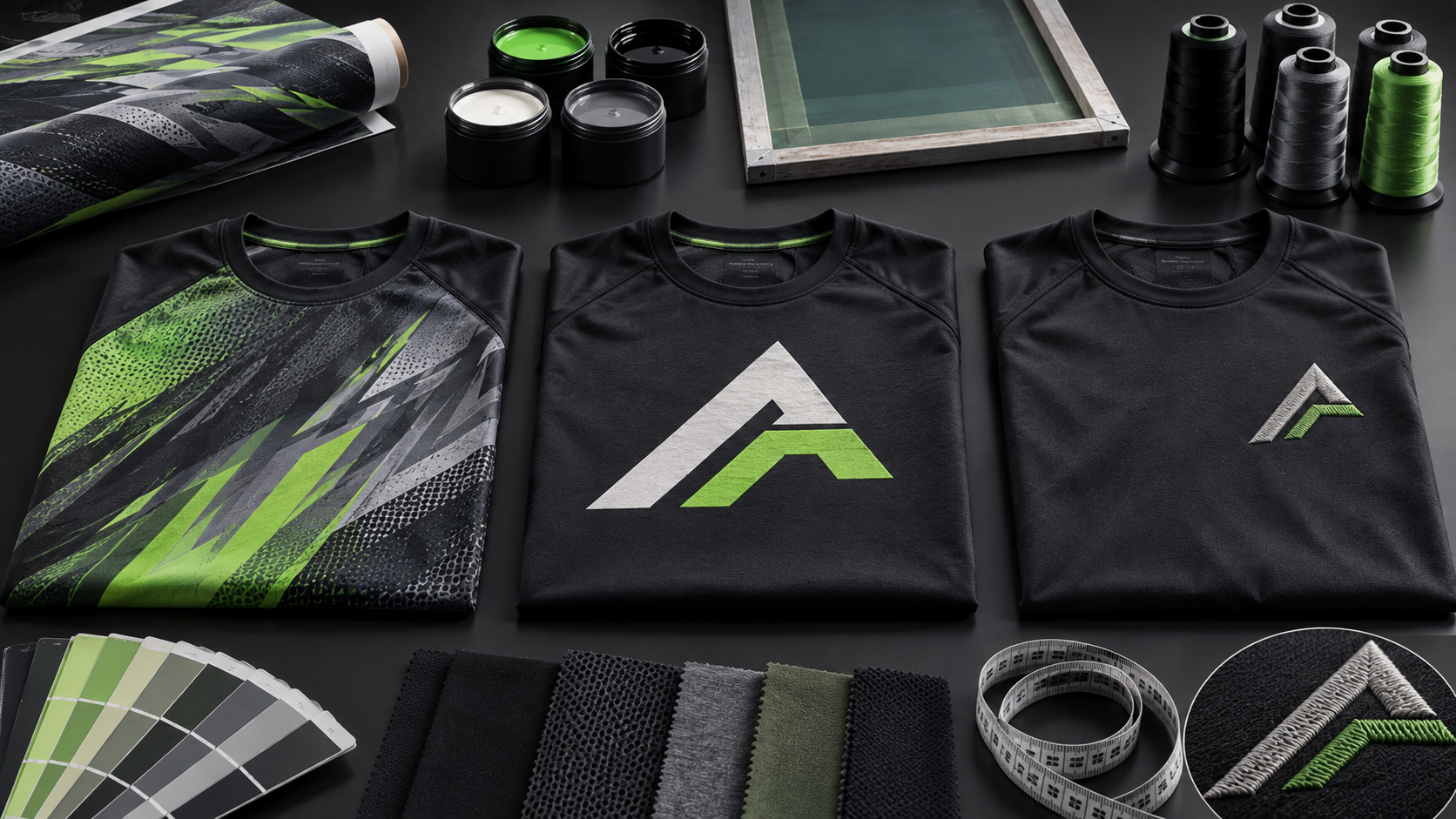
Screen printing pushes ink through a mesh stencil directly onto the fabric surface, and is best suited to bold, flat-colour graphics and logos in moderate to large quantities. Sublimation uses heat to turn dye into a gas that bonds permanently with polyester fibres, making it the standard choice for full-coverage, all-over, photo-realistic or gradient designs — most visible in team jerseys and patterned leggings. Embroidery stitches thread directly into the fabric to create a raised, textured logo, and is the default choice for a premium, durable brand mark on hoodies, caps and polos.
Understanding the mechanics behind each method — not just the finished look — makes it much easier to predict how a design will actually translate once it leaves the screen and becomes a physical garment. A gradient that looks striking as a flat digital mockup, for instance, simply isn't achievable through screen printing without an unreasonable number of separate colour screens, while that same gradient is exactly what sublimation is built for.
Screen printing works by creating a separate stencil (screen) for each colour in a design, then pushing ink through each screen in sequence onto the garment. It produces vibrant, opaque colour and is cost-effective at moderate to large order quantities, because once the screens are made, printing additional units is fast and cheap per piece. The tradeoff is the opposite at small quantities — screen setup costs are fixed regardless of order size, so a run of 50 units carries a much higher per-piece cost than a run of 500.
Screen printing works best for designs with a limited, defined number of solid colours. Highly detailed, photographic, or gradient-heavy designs are difficult and expensive to reproduce accurately with screen printing, since each additional colour requires its own separate screen and print pass.
Sublimation printing infuses dye directly into the fibres of the fabric using heat and pressure, rather than sitting a layer of ink on top of the surface. This makes it the go-to method for all-over prints, gradients, camo patterns, and photo-realistic graphics — the print becomes part of the fabric itself rather than a separate layer, so it doesn't crack, peel or fade the way a surface print eventually can. It's the standard method for sublimated team jerseys, where an entire garment needs a seamless, edge-to-edge pattern rather than a single logo placement.
The major limitation is fabric compatibility: sublimation only works reliably on polyester or high-polyester-content fabric, since the dye bonds with polyester fibres specifically. It doesn't work on cotton, and performs poorly on low-polyester blends. It also generally requires the fabric to be white or very light-coloured before printing, since sublimation dye doesn't cover or lighten an existing dark base colour the way screen printing ink can.
Because sublimated fabric is printed flat before the garment is cut and sewn, the design needs to account for how panels will align once assembled — this is different from screen printing or embroidery, which are applied after the garment is already constructed.
Embroidery stitches a design directly into the fabric using thread, producing a raised, textured finish that reads as more premium and durable than a printed logo. It's the standard choice for small, defined logo placements — a chest logo on a hoodie, a mark on a cap, a crest on a polo — rather than large or highly detailed graphics, since very fine detail becomes difficult to render accurately in stitched thread once a design gets much smaller than a few centimetres.
Embroidery is generally the most durable of the three methods against washing and everyday wear, since the thread is worked into the fabric structure rather than sitting on or bonding with the surface. It's also usually the most expensive per unit at small quantities, though — like screen printing — becomes more cost-efficient as order size increases, since the digitized embroidery file is a one-time setup cost.
The decoration method isn't a finishing touch you decide at the end — it should shape your fabric choice and pattern design from the start.Elevatex Editorial Team
All three methods carry fixed setup costs — screens for screen printing, a digitized file for embroidery, printed fabric yardage for sublimation — that get spread across your order size. This means the "cheapest" method depends heavily on quantity:
Sublimation is the most durable against fading and cracking specifically because the dye becomes part of the fibre rather than sitting on top of it — a well-executed sublimated design will typically outlast the garment itself. Embroidery is highly durable against washing and abrasion, though very fine detail can distort slightly over many wash cycles if thread tension wasn't set correctly during production. Screen printing durability varies significantly by ink type — a quality water-based or plastisol ink applied correctly can last the life of the garment, while a poorly cured or low-quality ink print can crack and peel within months.
It's often easier to picture the right method by product type than by abstract rule. A few common pairings from real production runs:
Sharing your product type and design style with your manufacturer early — rather than deciding on a decoration method independently and hoping it fits — usually surfaces the right choice quickly, and can also reveal fabric or pattern adjustments worth making before production begins.
A practical way to decide: if you need an all-over pattern, gradient, or photo-realistic design on a polyester fabric — team jerseys, patterned leggings — sublimation is generally the only method that will genuinely deliver it. If you need a bold, flat-colour logo or graphic at a moderate to large order size, screen printing usually offers the best balance of cost and visual impact. If you need a small, durable, premium-feeling brand mark — a chest logo on a hoodie, a cap — embroidery is typically the right call, provided the design isn't too fine or detailed for stitched thread to render accurately.
Many product ranges genuinely use more than one method across different styles — sublimated jerseys alongside embroidered training hoodies, for example — and a manufacturer experienced in custom apparel should be comfortable managing multiple decoration methods within the same order rather than pushing you toward a single technique across your entire range.
Whichever method fits your product, ask to see a physical sample of that exact decoration technique on the exact fabric you're planning to use, not just a portfolio photo of similar past work. A logo that looks crisp on a cotton t-shirt in a portfolio can behave very differently once embroidered onto a thin, stretchy performance fabric, and the only reliable way to know for certain is to see it applied to your actual material before committing to a full production run.
Elevatex International helps brands of every size — from first-time founders to established teamwear programs — go from a design brief to a finished, quality-checked product. Tell us what you're building.
Talk to Our TeamNo. Sublimation dye bonds with polyester fibres specifically, so it doesn't work reliably on cotton or low-polyester blends. Screen printing or embroidery are the appropriate methods for cotton-based garments.
It depends on the design. For a simple, one-colour logo, embroidery or screen printing are usually comparable at small quantities; for an all-over design, sublimation is often the only viable option regardless of order size, since it requires printed fabric yardage either way.
Yes, but it requires proper stabilization backing during stitching to prevent the fabric from puckering or distorting around the embroidered area, particularly on thinner or highly stretchy fabrics.
Sublimation tends to last the longest since the dye is bonded into the fibre itself rather than sitting on the surface. Embroidery is also highly durable. Screen printing durability depends heavily on ink quality and curing process.
Yes, this is common — for example, a sublimated all-over pattern combined with an embroidered logo patch, or a screen-printed graphic alongside an embroidered chest mark. Confirm with your manufacturer that they can sequence both processes on the same production run.

Private label is the fastest way to get a branded product line to market without building a factory. Here's exactly what a manufacturer handles, and what you still own.
Read Article
Club and league orders come with their own rules — full size runs, individual names and numbers, tight seasonal deadlines. Here's how a teamwear production run actually works.
Read Article
Between a design file and a finished hoodie sits pattern making, cutting, sewing, decoration, and finishing. Here's what happens at each stage, and why it takes the time it does.
Read Article