Private label is one of the most misunderstood terms in apparel sourcing, partly because it gets used loosely to mean several different things depending on who's saying it. For a brand deciding how to bring a product to market, understanding exactly what private label does and doesn't include is the difference between a smooth first order and a confusing back-and-forth about who's responsible for what.
Here's a clear breakdown of what private label sportswear actually means in practice, how it compares to related terms like white label and custom manufacturing, and what you need to bring to the table to make it work. It's a route used by brands at almost every stage — from a first-time founder launching a debut collection to an established retailer adding an apparel line without building their own factory relationships from scratch — precisely because it separates the manufacturing complexity from the brand-building work, letting each side focus on what they're actually equipped to do well.
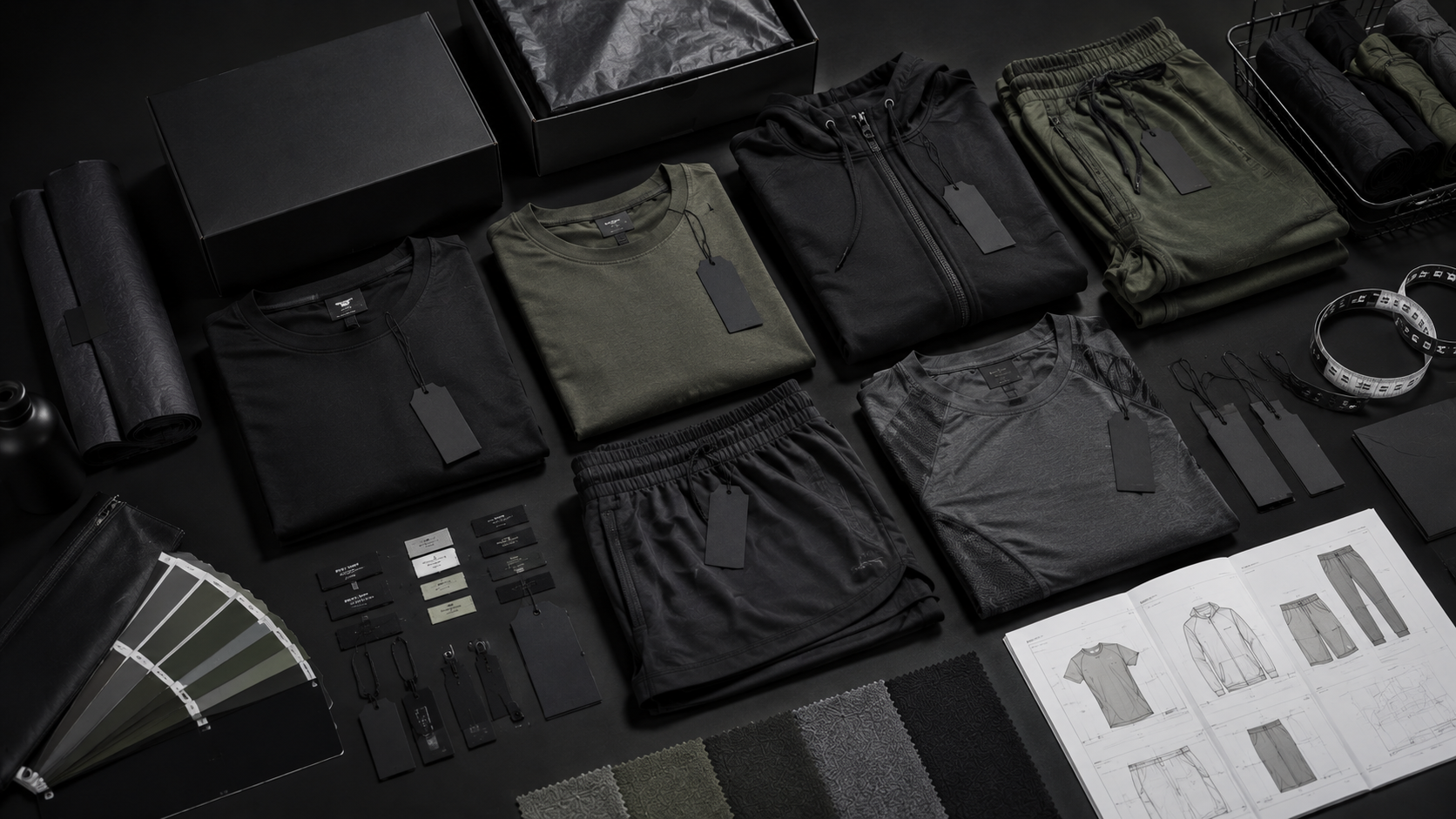
Private label manufacturing means a factory produces a product — using either their own base design (ODM) or your custom spec (OEM) — and applies your brand's labels, hang tags, and packaging to the finished garment, so it reaches the customer looking entirely like your product. The manufacturer typically remains invisible to the end customer; there's no co-branding or disclosure that a third-party factory made the item, which is standard and expected practice across the apparel industry, from small independent labels to some of the largest global sportswear names.
This is distinct from simply buying wholesale blank garments and adding your own labels afterward — private label production usually involves the manufacturer directly in decisions about fabric, fit, and construction, not just supplying a finished blank product for you to brand independently. The involvement of the manufacturer's development team, even on an ODM base pattern, is part of what distinguishes genuine private label work from a simple blank-and-brand arrangement.
These terms overlap enough to cause real confusion, so it's worth separating them clearly:
Private label sits in the middle: more brand-specific than white label, less development-intensive than full custom manufacturing. It's frequently combined with ODM development, since starting from a proven base pattern and customizing branding, colourways and minor fit adjustments is usually the fastest route to a genuinely branded product.
A private label product can be just as high quality as a fully custom one — the label doesn't determine the quality, the fabric, construction and manufacturer relationship does.
A private label manufacturer typically manages fabric sourcing, cutting, sewing, decoration (print or embroidery), attaching your labels and hang tags, quality inspection, and final packaging into polybags or boxes ready for shipment or, in some cases, direct fulfillment. Many manufacturers also offer support around minor pattern adjustments — a longer inseam, a different neckline — even within an ODM base pattern, without requiring a full custom pattern development process.
Depending on the manufacturer, additional services like barcode application, size sticker placement, or even drop-shipping directly to your customers may also be available, which can meaningfully reduce the operational load on a small team without in-house warehousing. It's worth mapping out, product by product, exactly which of these services a given manufacturer includes as standard versus offers as a paid add-on, since this varies considerably and directly affects how much operational work remains on your side once the finished goods arrive.
Even though the manufacturer handles production, the brand decisions remain entirely yours: product selection, colourways, pricing, marketing, customer relationships, and — critically — your brand identity itself, including your logo, label designs, and packaging artwork. A private label manufacturer produces to your direction; they don't make brand or marketing decisions on your behalf. This is worth clarifying explicitly if you're new to sourcing, since it's easy to assume a full-service manufacturer is handling more of the brand-building than they actually are.
This division of responsibility is actually one of private label's biggest advantages for a lean team: it lets a founder focus their limited time and budget on the things that most directly build brand value — positioning, marketing, customer experience — while outsourcing the capital-intensive, technically demanding parts of physical production to a partner already set up to do it well.
Private label gets your product made. It doesn't build your brand for you — that part stays entirely in your hands.Elevatex Editorial Team
Minimum order quantities for private label vary by product complexity and customization level, generally sitting somewhere between the very low minimums of pure white label blanks and the higher minimums typical of fully custom OEM development with bespoke fabric. Products using an existing base pattern (ODM-style) with your labels and a standard fabric colourway from stock generally carry more accessible MOQs than products requiring a custom-printed fabric roll, which has its own separate minimum yardage requirement. If MOQ is a major constraint for your first order, it's worth asking your manufacturer directly which specific products and customization levels fall within your target range, rather than assuming a single MOQ applies across their entire catalogue.
It's also common for MOQs to apply per colourway or per size run rather than to the order as a whole, which can catch new founders off guard when planning a launch across multiple colours. Confirming exactly how MOQ is calculated for your specific product — total units, units per colour, or units per size — before finalizing your order plan avoids an unpleasant surprise partway through the quoting process.
Before production can begin, you'll typically need to supply: your logo in a print-ready vector format, label artwork (woven or printed neck labels, care labels), hang tag design and copy, size sticker specifications, and packaging design if you want branded polybags or boxes rather than generic ones. Having these assets ready before you request your first sample — rather than scrambling to produce them once a sample is already approved — is one of the simplest ways to avoid unnecessary delay in a private label timeline.
If you don't yet have professionally designed label artwork or packaging, it's worth investing in this before your first production run rather than treating it as an afterthought once the garments themselves are sorted. A well-made product with a thin, poorly printed hang tag or a blurry woven label undercuts the quality impression the garment itself is trying to create — customers notice these details even when they can't articulate exactly why a product feels less premium than it should.
A typical private label order moves through: initial brief and product selection (a few days to a week), sampling with your labels and branding applied (one to two weeks, sometimes with a revision round), bulk production (three to five weeks depending on quantity and complexity), and final quality inspection and packing before shipment. Founders often underestimate how much of the early timeline is spent finalizing branding assets rather than waiting on the factory itself — getting your label artwork and packaging specs locked early keeps this stage from becoming the bottleneck.
It's also worth building in a small buffer beyond the manufacturer's quoted timeline for your first order specifically, since a first-time working relationship inevitably involves some back-and-forth as both sides learn each other's communication style and expectations. Subsequent orders with the same manufacturer, once that relationship is established, tend to move noticeably faster than the first.
Private label is generally the right fit for founders who want a genuinely branded product without the cost and timeline of full custom development — a strong option for a first collection, a smaller brand without in-house design resources, or an established retailer looking to add a branded product line without building manufacturing capability from scratch. It's less suited to brands whose entire value proposition depends on a proprietary, unreplicable garment construction, where full custom OEM development is usually the more appropriate route despite the additional time and cost involved.
It's also worth considering private label as a staged strategy rather than a permanent ceiling. Plenty of brands use private label production for their first one or two collections specifically to validate demand, gather real customer feedback, and build enough revenue and confidence to justify investing in fully custom pattern development for a second-generation product line. Treated this way, private label isn't a lesser version of "real" manufacturing — it's a deliberate, sensible first step that most successful apparel brands, even ones now known for highly distinctive product design, went through at some point on the way to where they are now.
Whichever stage you're at, the questions worth asking a prospective manufacturer stay largely the same as with any sourcing decision: what their sampling process looks like, what MOQ applies to your specific product, and how clearly they can walk you through what's included in their private label service versus what remains your responsibility. Our guide to choosing the right sportswear manufacturer covers this evaluation process in more depth.
Elevatex International helps brands of every size — from first-time founders to established teamwear programs — go from a design brief to a finished, quality-checked product. Tell us what you're building.
Talk to Our TeamNo. White label refers to a generic, unbranded product sold identically to multiple different brands, while private label involves a product developed specifically for your brand, even when based on an existing pattern, with your labels and packaging applied.
Not necessarily. Private label is often combined with ODM development, where the manufacturer's own design team adjusts an existing base pattern to your brief, meaning you don't need in-house pattern-making expertise to get a genuinely branded product.
At minimum, a print-ready vector logo file and label artwork. Hang tag design, packaging specs and size sticker details are also commonly needed before or during the sampling stage, so preparing these early helps avoid delays.
Yes, in most cases. Manufacturers offering ODM-based private label services can typically accommodate minor fit or construction adjustments to their base pattern without requiring a full custom pattern development process.
Private label using an existing base pattern generally involves lower development costs than full custom OEM manufacturing, since you're not commissioning a pattern from scratch, though bulk production pricing itself depends mainly on fabric, quantity and decoration method regardless of route.

Club and league orders come with their own rules — full size runs, individual names and numbers, tight seasonal deadlines. Here's how a teamwear production run actually works.
Read Article
Between a design file and a finished hoodie sits pattern making, cutting, sewing, decoration, and finishing. Here's what happens at each stage, and why it takes the time it does.
Read Article
A tech pack is the document that turns an idea into a garment a factory can actually cut and sew. Here's what belongs in one, and what happens when it's missing.
Read Article