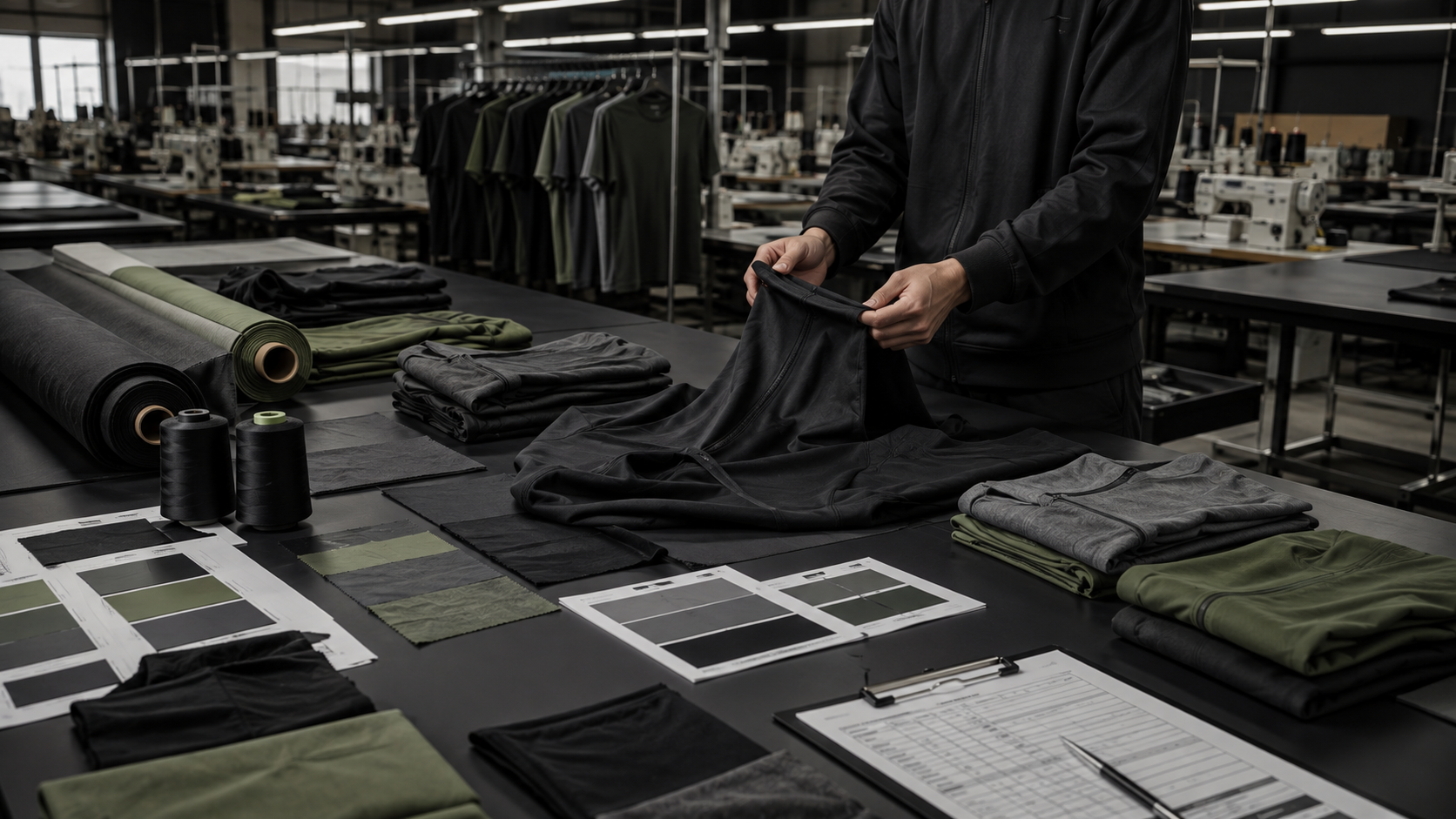
Search "sportswear manufacturer" and you'll find hundreds of factories, agents, and trading companies, most claiming similar capabilities and similar price ranges. For a first-time buyer, the options blur together fast, and the temptation is to default to whoever quotes the lowest price per piece. That's usually the wrong way to make this decision, because the cheapest quote rarely accounts for the cost of a bad sample, a missed deadline, or a batch that fails quality control after it's already been paid for.
This is a practical guide to evaluating a sportswear manufacturer before you commit — what to ask, what to watch for, and what a genuinely reliable production process actually looks like from the outside. None of it requires industry insider knowledge; most of it comes down to asking direct questions early and paying close attention to how specifically — or how vaguely — those questions get answered.
It's worth saying upfront: there's no universal "best" manufacturer, only the one whose process, order size, and communication style genuinely fit your brand's stage and requirements. A factory that's an excellent fit for a 5,000-unit reorder from an established label may be entirely wrong for a 300-unit first launch, and vice versa. The goal of this guide isn't to point you toward one type of supplier, but to give you a framework for evaluating whichever ones you're considering.
Manufacturing is a relationship, not a transaction, even on a relatively small first order. You'll be sending fabric specs, artwork, revisions, payment, and trust to a factory that's often on the other side of the world, and you won't see the product in person until it's finished — or close to it. A manufacturer that communicates clearly, holds to a sample-first process, and inspects before shipping saves you far more money over a year of orders than a marginally lower unit price ever will, because the real cost of a bad supplier shows up in reprints, delays, and damaged customer trust, not in the invoice.
A short, direct set of questions tends to reveal more about a manufacturer than a long back-and-forth about pricing. Worth asking early in any conversation:
A manufacturer confident in their process will answer these directly and specifically. Vague answers, especially around quality control and lead times, are worth probing further before you commit any payment.
Sample costs are separate from bulk pricing and almost always necessary. A manufacturer who waives or discounts sample cost against a confirmed bulk order is a reasonable, common practice worth asking about directly.
Some warning signs are obvious once you know to look for them, but easy to miss when you're excited about a fast quote and an eager sales response. The following patterns show up often enough in new founders' early sourcing conversations that they're worth naming explicitly.
The lowest quote and the most reliable partner are rarely the same manufacturer. Price tells you almost nothing about whether your order will arrive on time and match what you approved.Elevatex Editorial Team
A reliable process typically starts with a pattern or fit sample built from your tech pack or brief, which you review for fit, construction and fabric feel before any bulk fabric is cut. If revisions are needed, a second sample round follows — this is normal, not a sign of a problem. Only once you've formally approved a sample, in writing, should bulk cutting begin. This sequence exists specifically to catch fit and construction issues while they're cheap to fix, rather than after hundreds of units have already been sewn.
If a manufacturer's quoted timeline doesn't include any sampling stage at all, or treats it as optional, that's one of the clearest signals to look elsewhere — regardless of how attractive the unit pricing looks on paper.
Formal registration — with a local chamber of commerce or industry body, for example — is a reasonable baseline indicator of a legitimate, established operation rather than an informal reseller. Depending on your market and product category, you may also want to ask about specific fabric or safety certifications relevant to your buyers, particularly if you're selling into regions with stricter labelling or safety requirements. A manufacturer who can produce documentation readily, without hesitation, is generally more trustworthy than one who can't locate it when asked. This is a small thing to verify, but it's a quick way to separate an established production operation from an agent or reseller working without a direct factory relationship of their own.
How a manufacturer communicates before you've placed an order is a reasonable preview of how they'll communicate during production. Clear, prompt, specific answers to technical questions suggest a team that's organized internally. Slow, generic, or evasive responses — especially to direct questions about lead time or quality control — tend to predict the same pattern once your money and your deadline are on the line. Pay attention to whether responses address what you actually asked, or default to general marketing language regardless of the question.
It's also worth noticing what channel a manufacturer defaults to for updates once production begins. Manufacturers who proactively share progress — photos of fabric on arrival, cutting in progress, a finished sample ready for review — without being chased for updates tend to run a tighter, more accountable operation than ones who only respond when a client reaches out first. This single habit is one of the more reliable predictors of how smoothly a larger, longer-term order will go.
Not every manufacturer is the right fit for every order size. A factory built around large bulk runs for established brands may be a poor fit — slow, deprioritized, or simply uninterested — for a founder placing a first order of a few hundred pieces. Conversely, a smaller workshop comfortable with low-MOQ private label work may not have the capacity for a 10,000-unit seasonal order on a tight deadline. Ask directly whether your target order size is typical for that manufacturer, or whether you'd be an unusually small or large client relative to their normal production flow — either extreme can affect how much attention your order receives.
Standard practice in apparel manufacturing is a split payment structure — a deposit to begin production, with the balance due before or upon shipment, sometimes staged around specific milestones like sample approval or completion of bulk cutting. This structure protects both sides: the manufacturer isn't carrying the full cost of your order upfront, and you're not paying in full for a product you haven't seen finished.
Be cautious of manufacturers who insist on full payment upfront before any sample has been produced or approved, particularly for a first order with a new supplier. Equally, be cautious of a supplier unwilling to take any deposit at all on a legitimate order — this is unusual and can sometimes indicate an operation that isn't confident it can deliver. A clearly explained, staged payment structure tied to specific production milestones is one of the more reliable signals that you're dealing with an organized, established manufacturer rather than an informal middleman.
It's also reasonable to ask how payments are processed — bank transfer, escrow-style arrangements through a trade platform, or other methods — and to confirm this in writing alongside your quote, before any money changes hands.
Choosing a manufacturer is ultimately a bet on a working relationship you can't fully evaluate from a distance. Written specs, a real sampling process, and clear communication are the closest proxies available before you commit — and they tend to correlate strongly with how the rest of the relationship, across many future orders, actually plays out.
It's worth treating your first order, even a small one, as an audition for the manufacturer rather than only the other way around. Pay attention to whether their communication stayed consistent from first enquiry through to shipment, whether the sample genuinely matched what you approved, and whether they flagged problems proactively rather than waiting for you to notice them. A manufacturer that performs well across those three things on a modest first order is usually one worth building a longer relationship with — and the difference between a good manufacturing partner and a mediocre one tends to compound significantly as your order sizes and frequency grow.
Elevatex International helps brands of every size — from first-time founders to established teamwear programs — go from a design brief to a finished, quality-checked product. Tell us what you're building.
Talk to Our TeamThree to five is a reasonable range for a first order — enough to compare pricing, communication style and process without dragging the decision out for months. Focus more on how clearly each one answers your questions than on finding the single lowest quote.
Not necessarily. A very low MOQ can sometimes mean less favourable per-unit pricing or a less established production process. The right MOQ is the one that matches your budget and sales confidence, from a manufacturer whose process you trust.
A factory visit is valuable if it's practical, but not essential for a first order, especially when working with a manufacturer that provides clear written specs, sample approval steps, and pre-shipment inspection reports as standard practice.
Sampling generally takes one to two weeks, with bulk production following at three to five weeks depending on order size and decoration methods — though this varies by manufacturer and season, so always confirm a specific calendar in writing.
Compare quotes across several manufacturers for the same specification — same fabric, GSM, construction and decoration method — rather than comparing a bare per-piece number, since small spec differences can significantly change the real cost.

Not all polyester-spandex blends are equal. Here's how GSM, compression, moisture-wicking finishes, and four-way stretch actually affect how your gym wear performs and feels.
Read Article
Screen printing, sublimation, and embroidery each solve a different problem. Choosing the wrong one is how brands end up with logos that crack, fade, or never fit the fabric.
Read Article
Private label is the fastest way to get a branded product line to market without building a factory. Here's exactly what a manufacturer handles, and what you still own.
Read Article